
How to Get Dental Office Cleaning Contracts: Who Decides, What to Say, Who to Call First
Who signs for cleaning at a dental practice, what they’ll ask you for, front desk scripts, dental objections and how to qualify a call list.
Updated: 3 November 2026
To get dental office cleaning contracts, you need three things in place before you dial. You need to know who signs at each practice, a clear line between your crew’s work and the clinical team’s work, and the paperwork the practice will ask for before it lets you in after hours. Then you call, mostly reaching the front desk first, and ask for a walkthrough. This guide covers each step for dental practices only.
Why dental offices buy commercial cleaning
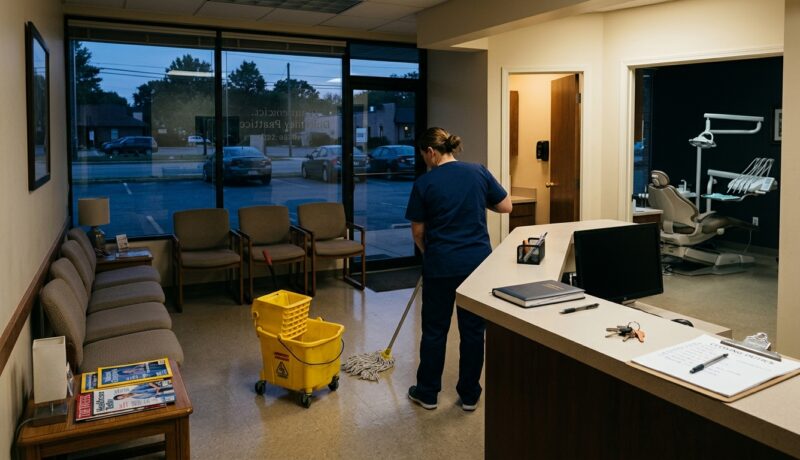
Patients judge a practice by the rooms they sit in before treatment. A stained lobby carpet or an untidy restroom shows up in Google reviews, and the practice sees those reviews. That is why commercial cleaning for dental offices tends to focus on the patient-facing areas: reception, waiting room, restrooms, hallways.
The work happens when the office is closed. Chairs are booked through the day, so your crew comes in the evening, early morning or on a day the practice is shut. Practices that switch cleaners often name problems you can check against yourself: missed nights, a different crew every week, lost keys, alarm calls, or staff redoing work in the morning.
Who decides
You will usually deal with one of three buyers. Each one says yes for different reasons, so find out which one you’re talking to before you pitch.
Office manager
In many single-location practices the office manager runs vendors: supplies, IT, the shredding company, the cleaner. They care about reliability and about not having to think about you. If the manager can sign, your job is to show the switch will be low effort for them.
Owner-dentist
In smaller practices the dentist may make the final call, sometimes after the manager makes a shortlist. The dentist sees the office for minutes a day between patients and rarely takes sales calls. Expect to go through the manager or front desk and to be asked for something in writing the dentist can read later.
Practice group (DSO)
A DSO (dental service organization) runs the business side for many practices under one company. Facilities contracts may be handled regionally or at head office, so the local manager may like you and still not be able to sign. You’ll hear “corporate handles that” here more than anywhere else.
How to tell which one you’re dealing with
Check the website and the location count before you call. It takes a minute per practice and changes your opening line.
| What you see | Likely buyer |
|---|---|
| One address, practice named after the dentist, “Meet Dr. [Name]” page | Owner-dentist, with the office manager as the first contact |
| One or two addresses, a team page that lists an office manager | Office manager |
| A “Locations” menu with many cities, the same brand on every site | Group or DSO |
| Footer or careers page names a parent company, or says the practice is “supported by” a company | DSO |
Edge case: a brand with 3 locations can still belong to one dentist who owns all 3. In that case the owner or a single manager often signs for all locations. Ask the front desk “Is cleaning handled here or for all your offices?” and write the answer down.
What the crew cleans and what it doesn’t
Dental offices usually have two kinds of space, and you only own one of them. Janitorial services for dental offices cover the non-clinical areas. The practice’s own staff handle the clinical side: treatment rooms (operatories), the chair and its attachments, instruments and the sterilization area.
The gray zone is the operatory floor and the trash. Some practices want your crew to mop operatory floors after hours. Others want nobody outside the clinical team in those rooms. Ask which one applies, ask which product they want on those floors, and put the answer in your written scope.
Waste is the second line. Your crew takes ordinary trash. Sharps containers and regulated medical waste are not yours unless the practice and your insurer both say otherwise. (Under the OSHA Bloodborne Pathogens standard (29 CFR 1910.1030), sharps and regulated medical waste in a dental office may only be handled by specifically trained and authorized dental healthcare personnel (DHCP) who have documented training and operate under the facility’s written Exposure Control Plan.)
A common mistake is promising to “disinfect the whole office” in your pitch. To a dental office manager, that sounds like you don’t know where the clinical side starts. Describe what you clean in plain room-by-room terms and stop at the operatory door unless they invite you in.
What they’ll ask you for
This section covers US practice only, and it is general information, not legal advice. Insurance, background check and privacy rules differ by state and by business. This is general information, not legal advice.
Have these ready in one PDF before you call. A manager who asks for them and gets them the same day sees a vendor who won’t need chasing.
- Certificate of insurance (COI). General liability at minimum. Some practices also ask to be named as additional insured, or ask about workers’ comp and a bond.
- Keys and alarm codes. Say who holds keys, how you log them, and what happens when a crew member leaves. Ask for a separate alarm code for your company so the practice can see your entries and cut access in one step.
- Background checks. Expect “Is your crew background checked?” Know your answer: who is checked, by whom, and how recent the check is.
- A written checklist. Room by room, how often, and what is excluded. The exclusions matter here, because they show you know the clinical boundary.
- Privacy. After hours your crew walks past the front desk, patient files and screens. Some practices ask you to sign a confidentiality agreement.
Script: dental front desk and office manager
The general calling process (list, opener, gatekeeper, follow-up) is in how to cold call for commercial cleaning contracts. The scripts below change it for dental offices. The front desk at a dental practice is also checking patients in, answering insurance calls and booking appointments. If a patient is at the counter, you will hear it and so will they.
Front desk
You: Hi, this is [Your name] with [Company]. I’ll be quick, I know you’ve got patients. Who looks after your office cleaning, is that your office manager? Front desk: That’s [Manager name]. She’s busy right now. You: No problem. Is there a better time to catch her today, or should I call back tomorrow? Front desk: Try after 3. You: Will do. One more thing, is cleaning handled here, or for all your offices?
If the front desk asks you to email instead, ask for the manager’s name and the email address, and confirm the spelling. Write down the name, the time they gave you and the answer about other offices. Keep the callback time in your own calendar.
When it fails: if the desk is plainly slammed, end in 1 line (“I’ll try later, thanks”) and call back at the time you noted. Pushing through a busy desk gets you remembered for the wrong reason.
Office manager
You: Hi [Manager name], this is [Your name] with [Company]. We clean offices after hours here in [City]. Quick question. Who does your lobby and restrooms right now, your team or a service? Manager: We have a service. You: Got it. Is there anything your team ends up redoing in the morning? Manager: Sometimes the restrooms aren’t great. You: That’s the kind of thing I’d want to see. Could I come by after you close one evening this week, 15 minutes? I’ll send our insurance certificate and a checklist before I come, so you know what we do and don’t touch.
[If true, add after the first line: “We already clean [number] dental offices in [Area].” Leave it out if it isn’t true.]
When it fails: if the manager says the current service is fine, don’t argue. Ask “Can I send our checklist so you have it if that changes?” and get the email address.
Dental-specific objections
“The dentist handles that”
This is often true in small practices, and it isn’t always a brush-off. Ask how the dentist prefers to get vendor information, and whether the manager will pass it on. Offer a 1-page summary with your scope, insurance and a walkthrough offer, since the dentist will read it between patients, not take your call.
You: Makes sense. What’s the best way to get something in front of Dr. [Name]? I can drop off a 1-page summary or email it to you to pass on.
When it fails: if you’re told the dentist “doesn’t do vendors”, ask who did the last vendor change. That person is your contact.
“We have a DSO contract” or “Corporate handles that”
The local manager may not be able to change vendors, so don’t pitch them. Ask a fact-finding question instead, and use the answer for every other location of the same group on your list.
You: Understood. Do you know if that’s decided regionally, or at head office? Is there a facilities contact I should reach?
Common mistake: calling 10 branches of the same group one by one. You’ll get the same answer 10 times. Mark them all in your notes after the first call and look for the regional or head-office contact instead.
“Our staff does it”
Small practices sometimes have assistants clean the lobby and restrooms at close. That time comes out of a clinical team’s day, but don’t say so in a way that sounds like criticism of them. Offer a smaller scope instead of the whole office.
You: A lot of teams handle the daily stuff. Would it help to have someone do floors and restrooms properly once a week, after hours?
When it fails: if they don’t see a problem, there isn’t a sale yet. Note the date of the call and try again in a few months, when staffing may have changed. Keep that date in your calendar.
Qualifying a dental list
A dental office cleaning leads list from Google Maps gives you a mix of practice types. Sort it before you call, so your first calls go to practices you can win and serve.
Solo practice vs group
Look for the same practice name at several addresses in your list, or a brand you recognize from other cities. Put those in a separate group and call them last, using the DSO questions above. A solo practice is usually the faster yes because the buyer sits in the building.
Specialties
The category field on each Google listing tells you more than “dentist”. Expect to see general dentists, pediatric dentists, orthodontists, oral surgeons, endodontists and emergency dental services in the same search.
- Oral surgery and endodontics: more clinical space relative to the lobby. Settle the clinical boundary on the first call, not at the walkthrough.
- Pediatric and orthodontic: often larger waiting areas with more families passing through. Expect the lobby and restrooms to be the main scope.
- Emergency dental services: check the listing carefully. Some are lead-generation pages, not a real office, and a rating built on 1 or 2 reviews tells you little.
Hours
Opening hours aren’t in a typical call list export, so check them on the Google listing or the practice website. Evening or Saturday hours shrink your cleaning window. A practice closed on a weekday gives you a daytime slot, which may suit a crew that already cleans at night elsewhere.
Reviews
Review count is a rough sign of how long a practice has been listed and how many patients it sees, not a measure of its floor space. Read the newest low-star reviews for words like “dirty”, “bathroom” or “waiting room”. A practice getting complaints about cleanliness has a reason to take your call, but don’t quote their reviews back to them on the phone.
Dental lists by city
We publish free sample lists of dental offices built from Google Maps searches. Each list shows 4 rows in full (phone and website), and the 4 change every week. The other rows show name, category, rating, reviews and address, with phone, email and website hidden.
- Dental offices in Oklahoma City
- Dental offices in Tulsa
- Dental offices in South Bend
- Dental offices in Fort Worth
- Dental offices in Charlotte
- Dental offices in Albuquerque
Lists for other cities and industries are on the free lead lists page.
Not in one of those cities? The free plan gives you 2 searches of 10 leads each, no card needed. Search “dental offices” in your city, check the hours and websites as above, and make your first 10 calls this week.


Comments are closed.