
How to Run a Commercial Cleaning Walkthrough: Questions, Measurements, Notes and Follow-Up
A commercial cleaning walkthrough is the on-site visit that every call, email and walk-in has been aiming at. You walk the space with the person who buys cleaning, and you leave with 3 things: the facts to write a scope (rooms, floors, fixtures, access, frequency), how and when they’ll decide, and an agreed date for
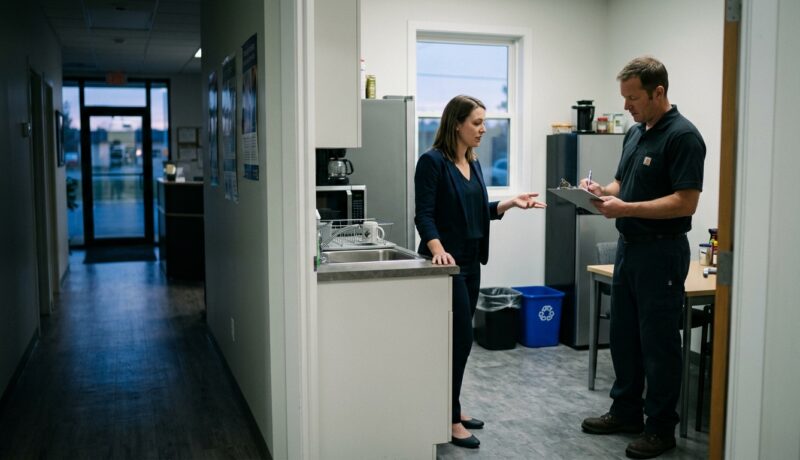
A commercial cleaning walkthrough is the on-site visit that every call, email and walk-in has been aiming at. You walk the space with the person who buys cleaning, and you leave with 3 things: the facts to write a scope (rooms, floors, fixtures, access, frequency), how and when they’ll decide, and an agreed date for your proposal. You don’t sell at the walkthrough, and you don’t quote a price on the spot.
This post covers what to bring, what to ask, what to measure, what to write down and how to follow up. It doesn’t cover pricing or bidding. Turning measurements into a number depends on your own production rates and costs, so where the walkthrough hands off to pricing, this post says so and stops.
What the walkthrough is for
A walkthrough, also called a commercial cleaning site visit or a janitorial walkthrough, does two jobs at once. You collect the facts you need to write a scope. At the same time, the buyer judges you: whether you arrived on time, came prepared, asked useful questions and stayed out of rooms you weren’t invited into. They can’t see your cleaning yet, so the visit is the closest thing they get to a sample of how you work.
A good outcome is three things: scope facts, the decision process, and the date they’ll get your proposal. A contract signed on the day does happen, but treat it as the exception. If you drive away without a proposal date, the visit hasn’t done its job, however friendly it felt.
The calls, emails and walk-ins on this site ask for a 15-minute walkthrough, so keep that promise. The 15 minutes are the manager’s time, walking and talking. When the walk is done, ask whether you may stay and measure on your own. If they say no, measure what you can as you walk and ask for a floor plan you can work from later.
Every script in how to cold call for commercial cleaning contracts aims at this visit. Once it’s booked, your job changes from getting a meeting to running one well. The rest of this post is about running it.
Before you go
Confirm the day before
Send a short text or email the day before. Confirm the time, which entrance to use, who will walk with you, and whether the visit is during or after business hours. One or two lines is enough: “Confirming tomorrow at [time]. Should I use the front entrance, and will you be walking with me?” If you get no reply, go at the agreed time anyway, and bring the manager’s direct number in case the door is locked.
Use the same message to ask whether anyone else who decides will be there: the owner-dentist, a regional manager, a church committee member. Many will say no, and that answer is useful too, because it tells you your proposal will be read by someone who never saw the space. The second visit you avoid is worth the question.
Re-read your notes and their website
Start with your notes from the call or walk-in: who you spoke to, who cleans now, the renewal date, and any complaint they mentioned. Then check the website and the Google listing. Opening hours give you the cleaning window, the number of locations tells you whether this site decides alone, and photos show you floors and finishes before you walk in.
Read the recent reviews for cleanliness complaints about restrooms, floors or the waiting room. Use them to decide what to look at closely, not as something to bring up. Don’t quote reviews back to the manager, the same rule the dental guide gives for the phone; the person walking with you may have read every one of them, or written the replies.
What to bring
- A measuring wheel or a laser measure
- Your walkthrough sheet on a clipboard (the fields are in “What to write down” below)
- Your phone, for photos (only with permission)
- Your certificate of insurance as a PDF on your phone
- A sample cleaning checklist, room by room
- Business cards
- Your calendar, open, for the proposal date and decision date
This is where the advice from walk-in prospecting flips. At a front desk, a clipboard looks like an inspection and makes staff guarded. At a walkthrough it’s expected: the manager invited you to look closely, and a sheet you fill in as you go shows you’re paying attention.
A common mistake is bringing your crew, or arriving in work clothes ready to clean. It looks as if you’ve already assumed the job, and extra people make a small office feel crowded during business hours. Come alone or with one partner, dressed clean and plain.
How to run the visit
The first 2 minutes
Thank them and ask how much time they have. Then ask to see the space in the order a crew would clean it, and ask permission to measure and take photos. Asking once at the start means you only need to ask again in rooms where it isn’t obvious.
You: Thanks for making time, [Name]. How long do you have today? Office manager: About 15 minutes. You: Could you walk me through in the order a crew would clean, front door to back? You: Is it OK if I measure as we go and take a few photos of floors and restrooms? I’ll ask before any room where it matters. You: If you need to get back after that, could I stay and finish measuring on my own?
When it fails: they have 5 minutes, not 15. Go straight to the restrooms and the main floors, ask the decision questions (who else decides, when, what paperwork), and ask for a floor plan so you can measure from it later.
Walk it in cleaning order
Follow the route a crew would take on a normal night:
- Entrance and lobby
- Offices and work areas
- Conference rooms
- Break room or kitchen
- Restrooms
- Back areas
- Janitor closet and water source
- Trash and dumpster
Walking in cleaning order keeps you from skipping a room, and it lets you picture the shift as you go. Let the manager talk while you walk. What they point at without being asked is often the real complaint, even if they told you on the phone that everything was fine. Write it down in their words, not yours.
Settle what you won’t clean, in the room
Decide exclusions on site, standing in the room, not later in the proposal. Typical ones are clinical areas, server rooms, locked private offices, and anything the manager says staff handle themselves. In dental and medical offices, the line between your crew and the clinical team comes first; the dental office cleaning guide explains where it usually sits. An exclusion agreed out loud in the room is harder to dispute later than one that first appears in your proposal.
Photos follow stricter rules than measurements. Never photograph screens, patient or client files, children or people, even in the background. Ask before every room where it isn’t obvious that photos are fine, and when you’re unsure, sketch the room on your sheet instead.
Questions to ask
These are the cleaning walkthrough questions to have on your sheet. Skip anything you already learned on the phone.
About the current cleaning
- Who cleans now, and for how long?
- What goes well?
- What do your staff end up redoing in the morning?
- When was the last complaint, and what was it about?
- How much notice does your current agreement require?
- When does it end?
Why it matters: what staff redo in the morning is the gap your scope has to close, and the notice period sets the earliest realistic start date.
About scope and frequency
- How many nights a week?
- What’s daily, what’s weekly, what’s monthly?
- Floor care: vacuuming, mopping, strip and wax, carpet extraction. Who does it now?
- Interior glass: how often, and who does it?
- Who supplies liners, paper towels and soap, and where are they stored?
Why it matters: floor care and consumables are where scopes often get misunderstood, so get a clear answer on who does and supplies what.
About access and security
- How do keys work, and who holds them?
- Can your company have its own alarm code? (A separate code lets them see your entries and cut access in one step.)
- Who opens and who locks up?
- Where should your crew park?
- After hours, is there elevator access, or stairs only?
- Are there cameras?
- What are the rules for after-hours visitors?
Why it matters: access is where a new cleaner causes visible problems in the first week, such as a false alarm or a door left unlocked, so settle it before anyone holds a key.
About the decision
- Who else decides?
- How will you compare cleaners?
- When will you decide?
- What paperwork do you need from me? (Certificate of insurance, references, a written checklist. The dental guide’s “What they’ll ask you for” section has the fuller list.)
- When would you want the new cleaning to start?
Why it matters: if someone else decides, your proposal has to work for a reader who never walked the space.
Questions to handle carefully
“What do you pay now?” is an option, with a trade-off. Some buyers share their current price without hesitating. Others hear the question as a pricing ploy and stay guarded for the rest of the visit. If you ask, ask once, and accept “I’d rather not say” without pushing.
Never criticize the current cleaner, even when the manager does. Agreeing that the last company was bad feels friendly in the moment, but the manager may have hired them, and they’ll wonder what you’ll say about them later. Write the complaint down and ask what good cleaning would look like to them instead.
What to measure and count
Measure and count these on every walk:
| Item | How to measure or count | Why it matters for the scope |
|---|---|---|
| Cleanable square footage | Measuring wheel or laser, room by room, or the floor plan minus excluded rooms | Sets the size of the job. Lease square footage includes areas you won’t clean. |
| Floor types by area | Note carpet, tile, VCT/LVT or sealed concrete for each room | Each floor type needs different equipment, products and frequency |
| Restrooms and fixtures | Count restrooms, toilets, urinals and sinks | Fixture counts drive restroom time on every visit |
| Trash and recycling points | Count bins per room and any central collection points | Every bin is a stop on every visit |
| Break room and appliances | List the appliances and ask which ones are in scope (inside the fridge, the microwave) | Appliance cleaning is a common source of “I thought that was included” |
| Entrance and interior glass | Count glass doors and partitions; note anything above head height | Glass often runs on its own frequency, and height decides the equipment |
| Stairs and elevators | Count flights and elevator cabs | Adds time and may need its own frequency |
| Traffic | Ask the manager roughly how many people come through per day | More traffic means more wear on floors and restrooms |
| Cleaning window | Opening and closing times, and whether anyone works late | Sets when your crew can start and how long they have |
| Water source, slop sink, supply storage | Find each one and note how far it is from the work areas | No slop sink means carrying water; no storage means bringing supplies every visit |
| Dumpster | Location and distance from the building | A long walk with trash adds time every night |
Measure only what you’ll clean. Don’t walk into an excluded room to measure it, even if the door is open, because it undoes the exclusion you just agreed. Note the room as excluded and move on.
A common mistake is using the building’s or the lease’s square footage as cleanable area. Lease figures often include shared common areas, mechanical rooms and wall thickness, none of which your crew cleans. Use your own measurements, or the floor plan minus the excluded rooms.
How these measurements turn into a price or a bid depends on your own production rates, labor costs and supplies. That part is yours, and this post stops here. What the walkthrough gives you is the input: measured areas, counted fixtures and a confirmed cleaning window.
What to write down
The walkthrough sheet
Your walkthrough sheet is a one-page commercial cleaning walkthrough checklist you fill in as you go. Use the same fields at every site so you can compare walkthroughs later:
- Date
- Who walked with you (name and role)
- Others who decide
- Current cleaner and renewal date
- Complaints, in their words
- Rooms in scope
- Exclusions
- Measurements and counts (from the table above)
- Access details
- Frequency wanted
- Documents requested
- Proposal due date
- Decision date
Fill in the gaps in the car before you leave, the same habit as after a walk-in. By the next stop, details blur: which restroom had the broken partition, which office was locked and excluded. Label photos with the business name and room the same day, and keep them in your own folder for that business.
Logging it
If you track leads in Leads for Cleaners, the walkthrough goes into the lead’s free-text notes. The app has 4 statuses (Not called, Called, Callback, Won) and no “Lost” status, so use them the same way as in the cold calling guide:
| What happened | Status | Notes |
|---|---|---|
| Walkthrough done, proposal not sent | Callback | “Walkthrough 2026. Proposal due 2026.” |
| Proposal sent | Callback | “Proposal sent 2026. Decision by 2026.” |
| Signed | Won | Start date, scope |
| Said no | Called | “Not interested” plus the reason, and the renewal date if they gave one |
Put the proposal due date and the decision date in your calendar, with the business name in the event title. A date that lives only in a note won’t remind you when it arrives.
Ending the walkthrough
Before you leave, recap in 3 lines: what you saw, what’s in scope and what’s out. Then name the day they’ll get your proposal, and confirm the decision date and who else will read it. The recap is your last chance to catch a misunderstanding while you’re both still standing in the building.
You: Let me check I’ve got it right. Nightly cleaning of [rooms in scope], [number] nights a week. You: Not included: [exclusions]. You: You’ll have my proposal by [day]. Who else should get a copy? Office manager: Send it to me. I’ll show [other decision-maker]. You: And you’re planning to decide by 2026? Office manager: Around then, yes.
Quoting on the spot and sending a written proposal each have a cost:
| Approach | What you gain | What you risk |
|---|---|---|
| Quote on the spot | Speed; the buyer hears a number while the visit is fresh | You price without checking your numbers, and a figure said out loud is hard to change later |
| Written proposal | Time to check your rates; a document that other decision-makers can read | Slower, and another cleaner may get their proposal in first |
When it fails: “Just give me a ballpark.” You can say you’ll send the full proposal by [day], and that a number without the scope behind it gets compared against the wrong thing. Some buyers accept that; if they insist, they’re telling you price decides. Write that on your sheet.
Following up after the walkthrough
Same-day thank-you email
Send a short plain-text email the same day. Mention the one thing they said matters most, in their words, and repeat the proposal date. Use the same signature block as in the cold email templates.
Subject: Thanks for the walkthrough today
Hi [Name],
Thanks for showing me around [Business name] today. I noted that [the thing they said matters most] is the priority.
You’ll have my proposal by [day].
[Signature]
When it fails: no reply. That’s fine and common; the proposal is the next touch, so don’t send a second email asking whether they got the first.
Sending the proposal
Send it by the day you promised. If you’ll be late, say so before the date, not after. A missed first deadline tells the buyer how you might handle a missed night.
The proposal should reflect what you agreed on the walk: scope room by room, frequency, exclusions, access arrangements, start date, and the documents they asked for. The price section is yours to work out. Writing the full proposal is a topic for a separate post.
Following up on the proposal
A hypothetical cadence, counted from the day you send the proposal. Alternate call and email, as in the cold calling guide:
- Day 2: Short email to confirm it arrived.
- Day 5 to 7: Call with one question, for example “Has [other decision-maker] had a chance to read it?”
- On the decision date: Call.
When they go quiet after that, send one last email asking for the decision, or for their renewal date if they’re staying with their current cleaner. If that gets no reply, park the lead and write “Parked: [reason]” in your notes, the same wording as for walk-ins. If you plan to try again before their renewal, put that date in your calendar.
When they say no
Ask one question: what made the difference? Then note the reason and the renewal date, and ask whether you may check back before then. Don’t argue with the decision; a buyer who said no and was treated politely may still call you when the other cleaner misses a night.
Adapting the walkthrough by business type
| Business type | Timing of the visit | What to look at closely | What to stay out of |
|---|---|---|---|
| Dental and medical offices | After the last patient, or on a day the office is closed | Waiting room, restrooms, hallway floors, and where the clinical side starts | Treatment rooms and sterilization unless invited; screens, files and sign-in sheets |
| Daycares | After the children leave | Restrooms, floors in play areas, kitchen or food areas | Never photograph rooms with children in them; don’t visit at drop-off or pick-up |
| Gyms | Between peak times, or late at night | Locker rooms, showers, equipment areas, and whether they’re open 24 hours (cleaning with members on the floor) | Locker rooms while in use; members in photos |
| Small offices and insurance agencies | End of the day or after hours | Who cleans common areas, the tenant or the landlord; restrooms shared with other tenants | Other tenants’ suites and areas the landlord’s cleaner already covers |
Sample lists for each row:
- Dental and medical offices: dental offices in Charlotte and medical offices in St. Louis
- Daycares: daycares in Fort Wayne
- Gyms: gyms in Evansville
- Small offices and insurance agencies: insurance agencies in Madison
Frequently asked questions
How long does a commercial cleaning walkthrough take?
There’s no measured number here. Plan on about 15 minutes of the manager’s time, plus however long you need to measure alone if they allow it. A small office suite takes less; a multi-floor building or a gym with locker rooms takes more.
Should you charge for a walkthrough?
Both options have a cost. A free walkthrough is easy to say yes to, and it matches the “15-minute walkthrough” offer in your calls and emails, but you’ll spend time on some visits that go nowhere. Charging filters out buyers who only want a number to compare, but they can book a cleaner who comes for free instead.
What if they only want a video call or photos?
For a small space it can work. You lose what a camera doesn’t show well: the real condition of the floors, smells, access and parking, fixture counts in rooms they skip, and the walk to the dumpster. Ask for a floor plan, and ask whether you can do an in-person visit before the start date.
What if the space is bigger than your crew can handle?
Say so on site or within a day, not after the proposal date. You can offer to scope part of it, such as one floor or the common areas, or decline and thank them for the time. The what a good first client looks like section of the Finding Clients guide covers which sites fit a small crew.
The next walkthrough comes from the next list. The free plan gives you 2 searches with 10 leads each, and you don’t need a card. Search one business type in your city and start calling for your next visit.


Comments are closed.