
Walk-In Prospecting for Commercial Cleaning: When to Go, What to Say, What to Write Down
Walk-in prospecting, also called door-to-door prospecting, is a short visit, not a sales pitch. Go when the front desk is quiet. Bring a business card and a one-page sheet, and ask who handles cleaning. Leave both, write your notes in the car the same day, and follow up within a day. The goal of a
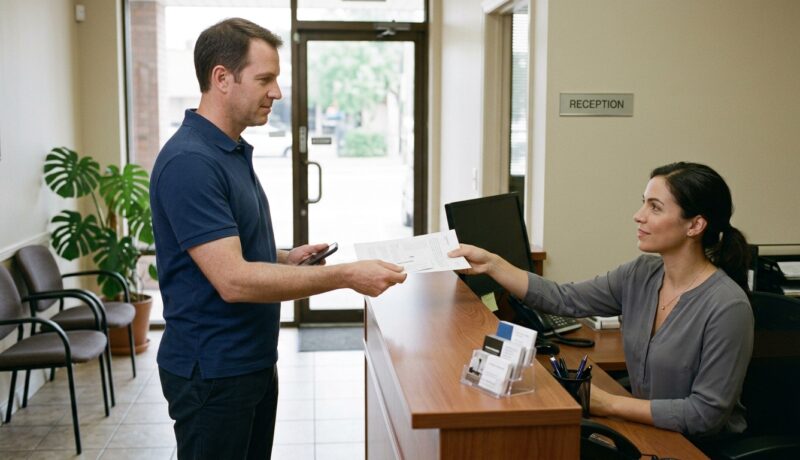
Walk-in prospecting, also called door-to-door prospecting, is a short visit, not a sales pitch. Go when the front desk is quiet. Bring a business card and a one-page sheet, and ask who handles cleaning. Leave both, write your notes in the car the same day, and follow up within a day. The goal of a walk-in is the decision-maker’s name and a good time to reach them. A walkthrough booked on the spot does happen, but treat it as the exception. This post covers the visit itself. Who to target and how to build your list are in How to Find Commercial Cleaning Clients.
What a walk-in can and can’t do
Door-to-door commercial cleaning sales has a narrower job than the name suggests. A visit can do four things a phone call often can’t:
- Put a face to your company name. The next email or call then comes from someone the front desk has met.
- Get the decision-maker’s name, spelled correctly, and the times they’re usually in.
- Show you the lobby and any restroom open to visitors. You may learn a bit about flooring, traffic and upkeep before you book a walkthrough.
- Reach businesses whose phone always goes to an answering service or a call center.
A walk-in can’t sell cleaning or produce a price. Nobody signs with a stranger at the counter, and you can’t price a space you haven’t walked. The cold calling guide explains why first contact is for a name and a meeting, and the same logic applies in person.
Here is what you’ll actually see: most visits end at the front desk. Your card goes into a drawer or onto a pile with other vendors’ cards. That’s normal, so don’t measure the visit by the card. Treat the card as your reason for the follow-up email (“I stopped by Tuesday and left my card with [name]”), not as the outcome.
Walk-in first, or call first?
You don’t have to choose one for every prospect. The question is which order fits the business in front of you. Here are the three common setups:
| Approach | When it fits | Trade-off |
|---|---|---|
| Walk-in as first contact | Storefront businesses with a staffed front desk; phones that always go to an answering service; office-building tenants that aren’t on Google Maps | Travel time per contact; you arrive knowing nothing about who decides |
| Call first, then walk in | The call got a name but no meeting, or the front desk said “just stop by” | You need something new to say when you arrive |
| Walk-in as the Day 14 drop-in | You’re already running the call → email → drop-in cadence from the cold calling guide | Only reaches leads already in your cadence; slower per lead |
Walking in first fits best where the phone is a dead end. A dental office that routes every call to a call center may still have a person at the counter. Tenants in an office building often have no Google Maps listing at all, and the lobby directory is how you find them (the Finding Clients pillar covers building lobby directories as a source). If you’re working out how to get commercial cleaning clients door to door, start with these three groups.
The main trade-off is travel time per contact. As a hypothetical: if one morning gets you through either 30 calls or 5 visits, the visits only pay off if they get you names the calls wouldn’t. Track it for your own area before you decide one channel is better.
A common mistake is walking into a business you called that same morning with nothing new to say. The front desk remembers the call, and the visit feels like pressure. Wait a few days, or bring something the call didn’t have, like the one-page sheet.
When to go
The general rule: go when the front desk is quiet, not during the business’s busiest hour. Treat every window below as something to test, not a fact. Hours vary by business, so check the posted hours on the business’s website or Google listing before you go.
| Business type | Likely quiet window to test | What to check first |
|---|---|---|
| Dental and medical offices | Mid-morning or mid-afternoon, between patient rushes | Lunch closing; appointment-only offices; locked doors |
| Small offices and insurance agencies | Mid-morning or mid-afternoon on weekdays | Whether there’s a receptionist at all; suites open by appointment only |
| Gyms | Mid-morning or early afternoon, between class blocks | Staffed hours vs key-fob-only hours; when the manager is on site |
| Daycares | Mid-morning, after drop-off has settled | Buzzer or intercom entry; the director’s office hours |
| Churches | Weekday office hours | Which weekdays the office is open; events on the calendar |
| Property management offices | Mid-morning on weekdays | Office hours; whether the office is on site at a property or elsewhere |
Lunch is the most common trap. Many small medical and professional offices lock the door or leave the desk empty for an hour, so a midday stop can mean a wasted trip. Fridays are worth checking too, since some offices close early or run reduced hours. For appointment-only offices and locked doors with a buzzer, say your name and company through the intercom and ask your one question there. Don’t ask to be let in.
Write the time of every visit in your notes. After 20 to 30 visits, compare which windows got you a name and which got you a closed door. It’s the same testing logic as call times in the cold calling guide.
When not to walk in
Some visits cost you the prospect. Skip these:
- Medical and dental offices during busy patient hours. If the waiting room is full or there’s a line at the counter, leave and come back. Don’t read screens, sign-in sheets or anything on the desk, even by accident; stand back from the counter.
- Daycares at drop-off and pick-up. Staff are handing children to parents and won’t have time for you. At secured entries, speak through the intercom or the door. Don’t ask to come in, and never ask to see rooms where children are.
- Gyms at peak class times. The front desk is checking members in. Come back between classes.
- Churches during services, funerals and events. Check the calendar on the website and visit on an office day instead.
- Any business with a “No soliciting” sign. Call or email instead, and see the rules section below.
- Office buildings with a security desk. Ask at the desk. Don’t follow tenants through a badge door.
- Residential addresses. A home-based business is not a commercial cleaning prospect. Remove these before you plan a route (the Finding Clients pillar covers this in its “remove the wrong prospects” step).
If someone asks you to leave, leave, and note the business as do-not-contact.
What to bring
Pack the night before so every stop starts the same way:
- Business cards. Enough for every stop on your route plus spares. You’ll often hand over two: one for the front desk, one for the decision-maker.
- A one-page sheet. Keep it to:
- Your company name
- What you clean, room by room, in plain terms (lobby, offices, restrooms, break room, floors)
- The area you serve
- Your phone number
- The walkthrough offer
- Your route list, printed or on your phone, with business name, address and the hours you looked up.
- Your calendar, open, so you can offer two walkthrough times on the spot.
- Your certificate of insurance on your phone, in case someone asks. Don’t hand out copies unasked.
Dress clean and plain, in a company shirt if you have one. A common mistake is arriving with your whole crew in uniform, which looks like you’re there to work, not to talk. A clipboard has a similar problem: it can look like an inspection, and the front desk gets guarded.
Optional leave-behind items (pens, small snacks, branded magnets) are a trade-off. They add a cost to every stop, and you have no way to know whether they get you remembered or thrown out. If you try them, track the stops with and without them before you make it a habit.
The front desk conversation
The person behind the desk is busy, and they aren’t the buyer. Their job is answering phones and helping the people in front of them, and you’re an interruption. Aim for under 60 seconds unless they keep the conversation going.
Opening
You: Hi, I’m [Your name] with [Company]. We clean [business type] around here.
Quick question. Who handles the cleaning for the office?
Front desk: That’d be [name], our office manager.
You: Thanks. When is [name] usually around?
When it fails: you hear “We’re not interested” before you get a name. Try one fallback line, “Understood. Who would handle it if that ever changed?” If that doesn’t work, leave your card and sheet and go.
“Just leave your card”
Front desk: Just leave your card.
You: Sure, here’s my card and a one-page sheet. Who should I write on it?
Front desk: [Name].
You: Is that [spelling]? And what’s the best email for [name]?
When it fails: they won’t give a name. Write “front desk, no name” and the time in your notes. Follow up by phone at a different time of day, when someone else may answer.
When the decision-maker comes out
Office manager: Hi, I’m [name]. What can I do for you?
You: Thanks for coming out. I’m [Your name] with [Company]. Three quick questions, if that’s OK.
Who cleans for you now?
Anything you’d change about it?
When does that agreement come up for renewal?
You: I’d like to do a short walkthrough so I can give you real numbers. Would [day] at [time] or [day] at [time] work?
If they offer to show you the space right then, look only at the areas they lead you through. At medical and dental offices, don’t step into treatment rooms unless they invite you; the dental office guide covers the clinical boundary.
When it fails: “Just send me a quote.” You can’t price a space you haven’t seen, so ask for the walkthrough again; the cold calling guide covers this answer in full.
“We already have a cleaning company” in person
Office manager: We already have a cleaning company.
You: That makes sense. When does that agreement usually come up?
Would it be OK if I checked back a month or so before then?
When it fails: no date and no permission. Thank them, leave the sheet, and note “has cleaner, no renewal date.” Step 5 of the cold calling guide has the full version of this objection.
Office buildings: security desks and lobby directories
Security: Can I help you?
You: Hi, I’m [Your name] with [Company]. We clean offices nearby.
Who manages the building? Is there a management office I can contact?
There are two routes into a building. The property manager hires cleaning for common areas (lobby, hallways, shared restrooms) and may know which tenants arrange their own cleaning. Tenants who lease suites often contract their own cleaning, so each one is a separate prospect. Ask security or the building office which applies here; the answer changes who you call next.
Read the lobby directory, and photograph it only if that’s clearly allowed (ask security if you’re unsure). Add the tenants to your list for a later call or email rather than going floor to floor.
When it fails: security won’t let you up. Ask for the management office’s contact details, thank them and leave.
Routing visits by neighborhood
Group your stops by ZIP code or a cluster of streets. Then order them so each stop lands in its quiet window from the hours you checked earlier. Offices that close for lunch go first or last, not at noon.
A hypothetical route: say you pick 5 dental offices across 2 neighboring ZIP codes. You spend 5 to 10 minutes at each stop and 10 to 15 minutes driving and parking between them. That’s roughly 2 hours for the whole trip. Your own numbers will depend on traffic, parking and how often you wait at the counter.
Plan around work you already have. If you clean a building on a street, visit the businesses near it first. You can then honestly say “We clean the building down the street.” Only say it when it’s true.
If you build your list in Leads for Cleaners, export it as CSV, sort it by address, and paste the addresses into your own map app. The tool doesn’t plan routes or show a map; the ordering is up to you. The public list of dental offices in Oklahoma City shows the address for every one of its 100 businesses. Phone and website are masked on all but 4 rows, but the addresses alone are enough to plan a walk-in route.
A common mistake is a route that spans the whole metro area, where driving eats the morning. Keep each route inside the service area you defined in the Finding Clients pillar.
What to write down after each visit
Write your notes in the car before you drive to the next stop. It’s the same habit as writing notes before the next dial in the cold calling guide. By the third or fourth stop, the details of the first one will blur together.
Use the same template every time:
- Date and time
- Who you spoke to (name, role, or “front desk”)
- What they said (current cleaner, renewal date, who decides)
- What you left (card, sheet)
- What you saw in public areas (flooring, restrooms open to visitors, approximate size)
- Next step
- Next date
- Source: Walk-in
Writing “Walk-in” as the source lets you compare channels later, as the Finding Clients pillar suggests.
If you track leads in the app, use its 4 statuses: Not called, Called, Callback, Won. They’re named for calls, so a walk-in uses the same ones. There is no “Lost” status, and the app has no follow-up dates.
| What happened | Status | Notes |
|---|---|---|
| Not visited yet | Not called | Hours checked, planned route day |
| Front desk only, no name | Called | “Walk-in. Front desk, no name. [Date, time]. Left card + sheet.” |
| Got a name and a good time | Callback | Name, role, best time, email if given |
| Has a cleaner, gave a renewal date | Callback | Current cleaner, renewal month, permission to check back |
| Walkthrough booked | Callback | Walkthrough date and time |
| Not interested, or asked to leave | Called | “Not interested” or “Do not contact,” plus the reason |
| Signed | Won | Start date, scope |
Every next date goes in your own calendar, with the business name in the event title. A note in the lead won’t remind you of anything.
Following up after a walk-in
Send an email the same day or the next. Use Template 5, “After a drop-in,” from the cold email templates. Mention the day you visited and the name of the person you left the card with.
If you didn’t get an email address, call within 2 to 3 days. Open with the visit: “I stopped by Tuesday and left my card with [name].” That one line tells the front desk you’re not a cold caller.
Don’t visit the same business again within the same month unless someone invites you. A second unannounced visit with nothing new reads as pressure. Use a call or email in between.
As a suggestion, not a measured rule: after 1 visit, 1 email and 1 call with no name and no reply, park the lead. Leave the status as Called and write “Parked: [reason]” in the notes. If you plan to try again later, put that date in your calendar.
US rules to check before you walk in
This section applies to the United States only and provides general information, not legal advice. Rules governing in-person business solicitation vary by state and locality. Before planning visits, check the requirements that apply to your location, including:
- “No soliciting” signs. Check whether local ordinances regulate business-to-business visits and how they treat posted “No soliciting” signs. Consult the applicable municipal code.
- Solicitor or peddler permits. Check whether your city or county requires a permit for commercial door-to-door visits, and whether the rules differ for commercial and residential properties. Consult the municipal code or contact the city clerk.
- Trespassing. Respect property restrictions and any request to leave. If asked to leave, do so promptly.
- Medical offices and patient privacy. Avoid viewing patient information, including computer screens, sign-in sheets, and paperwork. Keep a respectful distance from reception counters and follow the office’s instructions.
Frequently asked questions
How many walk-ins can you do in a day?
There’s no measured number here. It depends on how close your stops are, parking, and how many offices close for lunch. The hypothetical route above, 5 stops in about 2 hours, is a planning starting point, not a target.
Should you walk in or call first?
It depends on the business. Walk in first where the phone always goes to an answering service, or where the prospect isn’t on Google Maps. Otherwise, use the table in “Walk in first, or call first?” to pick an order.
Should you ask for a walkthrough on the spot?
Only when the decision-maker is there and offers you time. Otherwise, offer two times later in the week and put the one they choose in your calendar. Pushing for a walkthrough from the front desk usually ends the conversation.
Can you walk into businesses inside an office building?
Start at the security desk or the building office, not the tenants’ doors. Ask who manages the building and read the lobby directory for tenant names to contact later. The office buildings section above has the script.
To start, sign up for the free plan: 2 searches with 10 leads each, no card needed. Search your business type and city, export the list, sort it by address, and plan one route of 4 or 5 stops for this week.


Comments are closed.