
What to Include in a Commercial Cleaning Proposal: Scope, Access, Terms and Follow-Up
Scope, frequency, access, insurance, term and acceptance: how to write each part of a cleaning proposal, with a copy-ready skeleton and follow-up scripts.
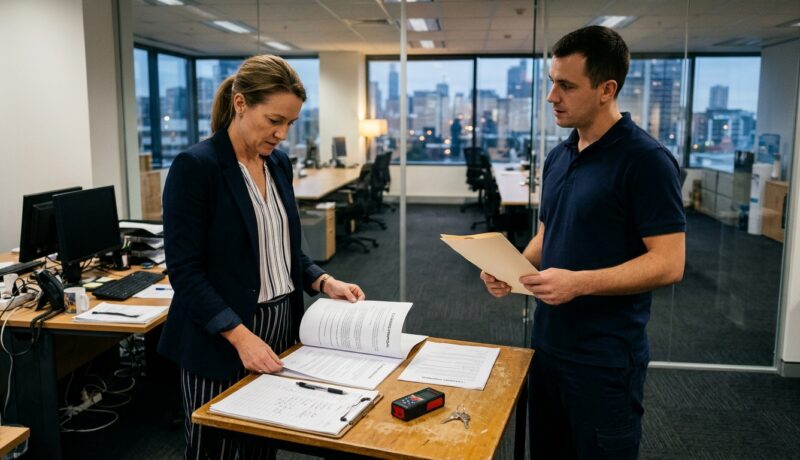
What to include in a commercial cleaning proposal comes down to one test: can someone who never saw the building read it and say yes? A proposal puts what you agreed on the walkthrough in writing. It has 12 parts: header, what you heard, scope by area, frequency, exclusions, access and keys, supplies, insurance and documents, start date and term, ending the agreement, price and payment, and acceptance.
This post doesn’t cover price numbers, because those come from your own costs. It picks up where the walkthrough ended, with your sheet filled in and a proposal date promised. If you haven’t walked the site yet, do that first, because every part below depends on what you measured and agreed there.
The 12 parts of a commercial cleaning proposal
Use this table to build the document from your walkthrough sheet. If a field is blank, ask the buyer rather than guess. A short email with one question costs you less than a wrong line in a signed scope.
| Part | Question it answers | Where it comes from on your sheet |
|---|---|---|
| Header | Who is this for, which site, and how long does it stand? | Date; Who walked with you |
| What you heard | Did you listen? | Complaints, in their words |
| Scope by area | What gets cleaned, room by room? | Rooms in scope; Measurements and counts |
| Frequency | How often, on which nights, in what window? | Frequency wanted; cleaning window from your measurements |
| Exclusions | What is left out? | Exclusions |
| Access and keys | Who gets in, and how? | Access details |
| Supplies | Who buys, stocks and reorders what? | Supply storage from your measurements; your notes on liners, towels and soap |
| Insurance and documents | What can they verify? | Documents requested |
| Start date and term | When do you start, and for how long? | Current cleaner and renewal date; your note on their notice period |
| Ending the agreement | How can either side get out? | No sheet field. These are your terms, so decide them first. |
| Price and payment | What does it cost, and how do they pay? | Your own numbers, worked out from Measurements and counts |
| Acceptance | Who says yes, by when, and how? | Others who decide; Decision date |
Before you write
Write for the reader who wasn’t there
The manager who walked with you may forward your janitorial proposal to an owner-dentist, a franchise contact or a church office. That reader won’t remember your handshake or the broken partition you both looked at. Each section has to make sense without you in the room to explain it.
Test it by reading each section alone. “Restrooms as discussed” fails, because the owner wasn’t in that discussion. “2 restrooms, 3 toilets, 2 sinks, cleaned each visit” works for anyone. Length follows the job: a one-suite office needs less paper than a 3-floor building, and padding a small job makes a buyer wonder what’s hidden in it.
Quote, proposal or contract
Buyers use these words loosely, and so will you. Pick one meaning for your own paperwork and use it every time. The table shows the usual difference.
| Document | What it is | When to use it |
|---|---|---|
| Quote | A price for a described job | A small one-time job with little to explain |
| Proposal | Scope, terms and price for a buyer to review | Recurring work, or a cleaning bid proposal someone else has to approve |
| Service agreement | The signed terms both sides will work under | After the yes, or in place of an acceptance line |
You have 2 options. With option A, the proposal ends in an acceptance line, and the signed proposal is the paperwork. It’s faster and gives the buyer one document, but it has to carry every term you care about. With option B, the proposal gets the yes and a separate service agreement follows. It adds a step, and it gives you room for fuller terms and a lawyer’s review.
Header and what you heard
The header needs 5 things: the business name, the site address, your contact person, the date, and a valid-until date. Spell the business and the contact the way they do. A wrong name on page 1 tells the reader how you might treat their building.
Follow it with 2 or 3 lines repeating what the buyer said, in their words. “You told me staff redo the restrooms most mornings, and that the lobby floor is the first thing patients see” shows you were paying attention. Don’t name or criticize the current cleaner, even if the manager did. The person reading may be the one who hired them.
Keep your company overview to a few lines: who you are, what area you serve, and how to reach you. Buyers want to get to the scope, and a long history of your company pushes it down the page.
Scope by area
Write the scope room by room, in the same cleaning order you walked: entrance, offices, conference rooms, break room, restrooms, back areas, then trash. Use plain task verbs with your measured counts. Anyone should be able to check the work against the page on a Tuesday morning. If you need the measuring list again, it’s in how to run a commercial cleaning walkthrough.
Here is a hypothetical small office, as an example of the level of detail:
- Entrance and lobby: vacuum carpet, damp mop tile, spot clean glass door, empty 2 bins
- Offices (6 rooms): vacuum, dust clear surfaces, empty 6 bins
- Break room: wipe counters, sink and appliance exteriors, mop floor, empty 1 bin
- Restrooms (2 rooms, 3 toilets, 2 sinks): clean fixtures, mirrors and partitions, refill dispensers, mop floors
- Trash: bag and carry to the dumpster behind the building
State the size as cleanable square footage, meaning the area your crew actually cleans, and leave out the lease figure. Lease figures can include shared areas and mechanical rooms your crew won’t touch. If the lease figure is higher than what you measured, the difference will come up when someone compares bids, so show what you measured and what you left out.
The common mistake is a line like “disinfect the whole office.” To a dental office manager it can sound as if you don’t know where the clinical side starts, and the dental office cleaning guide explains that line. In child care, clean, sanitize and disinfect mean different things, so the daycare cleaning guide is worth reading before you use any of those words. Name the room, the surface and the task instead.
One edge case comes up in multi-tenant buildings: shared restrooms that belong to the landlord. If the landlord’s cleaner covers them, write that they’re out of scope and who covers them. If you’re adding them, confirm that the landlord agrees, because the tenant may not have the right to hire you for them.
Frequency
A frequency table shows the buyer the whole year of work on one screen. Fill it in from your sheet, and leave a cell empty rather than writing a task twice. The rows and marks below are a hypothetical example.
| Task group | Nightly | Weekly | Monthly | Periodic |
|---|---|---|---|---|
| Trash, restrooms, break room | X | |||
| Vacuum and mop main floors | X | |||
| Dust surfaces and ledges | X | |||
| Vents and high dusting | X | |||
| Interior glass | X | |||
| Floor care (strip and wax, carpet extraction) | Per your agreed schedule |
Avoid “as needed”, because nobody knows who decides. If a task depends on condition, say who makes the call and when: “Your office manager requests carpet spot cleaning by email; we do it on the next scheduled night.” State nights per week and the cleaning window too, for example “Monday, Wednesday and Friday, between 6:30 pm and 10:00 pm.” Floor care and interior glass get their own frequency, since a buyer and a cleaner can remember those lines differently.
Then cover the nights that don’t go to plan. Say what happens on holidays and closure days: whether you skip the night, move it, or bill it. Say what happens when a crew can’t come, including who you tell, by when, and how you make it up. A buyer who has dealt with a missed night will look for this paragraph.
What’s excluded
List the exclusions you agreed in the room, and add no new surprises. If something occurs to you at your desk, ask the manager before you write it down. An exclusion the buyer first sees in the proposal can read like a change to what you said on site.
A typical list includes:
- Clinical areas
- Server rooms
- Locked offices
- High glass
- Inside appliances
- Anything the manager said staff handle
List sharps containers and regulated waste as excluded in dental and medical work, and use the dental guide above for the reasoning. For anything extra, write how it gets added: the buyer asks in writing, you price it, and they approve it before the work is done. One sample line covers most of it: “Not included unless added in writing.”
The trade-off is tone. A long list can read as defensive, especially to a buyer who only wanted a clean lobby. Keep it specific to this building: “the 2 locked offices on the east side” reads better than a boilerplate list of things that don’t exist there.
Access and keys
Describe how access works, and leave the codes out. Proposals get forwarded, so never put alarm codes or key locations in the document. Write the arrangement instead: who holds keys, how they’re logged, that your company uses its own alarm code, who opens and locks up, where the crew parks, how after-hours elevators work, and who gets the alarm call.
State what happens with a lost key and who pays for re-keying. A small private buyer may never ask, but you’ll want the answer in writing before it happens. For one labeled example of buyer-written terms, a 2026 janitorial bid specification from the Town of Winterville, North Carolina requires a listing of all keys and who holds them, bans duplicating keys, makes the contractor cover re-keying for a missing key, and requires keys back at termination. That’s a public-sector document, and it doesn’t show what small private buyers do.
Add a short crew paragraph: who will enter the building, and whether that crew stays the same. Give background check facts only if they’re true, including who is checked, by whom, and when. Add your visitor rule (no friends or family on site), the sign-in log if the building uses one, and a confidentiality line if they asked for one. A sentence you can’t back up on night one is worse than leaving it out.
Supplies
Consumables are where a buyer and a cleaner can each assume the other one is paying. A short table settles it. Fill in each cell with a name, and don’t leave “TBD” in a document you’re asking someone to sign.
| Item | You supply | Client supplies | Who reorders |
|---|---|---|---|
| Chemicals and equipment | |||
| Trash liners | |||
| Paper towels | |||
| Toilet tissue | |||
| Hand soap |
Add 2 details below the table: where supplies are stored, and whether your refills fit their dispensers. A dispenser built for one brand of towel is the sort of thing you find out at 7:00 pm on night one. If you’re taking over a locked dispenser, ask who holds the dispenser key too.
Dental and daycare buyers may want the product list agreed in writing. Attach it, and don’t swap a product later without telling them. On your price page, say whether consumables are included or billed separately, with no surprise line added later.
Insurance and documents
This section covers US practice only. This is general information, not legal advice. Insurance requirements differ by state and by buyer, so confirm the details with your agent.
State what you carry in the same terms as your certificate, and don’t round it up or describe it in your own words. Attach the certificate if they asked for it. If they didn’t, say when it will arrive, for example “before the first night.” Check the expiry date before you send, because an expired certificate tells the reader nobody is watching the paperwork.
Two terms get mixed up. A certificate holder is the party the certificate was issued to, and an additional insured is a party added to the coverage under the policy. The ACORD 25 certificate form says it is issued for information only and gives the holder no rights, and that a statement on the certificate doesn’t stand in for an endorsement. So wording in your proposal doesn’t change your policy. If a buyer asks to be an additional insured, ask your agent before you promise it.
Say “bonded” or mention workers’ comp only if it’s true. A buyer may ask for proof of either one. Don’t write anything your paperwork can’t back up.
End the section with a list of attachments: certificate, cleaning checklist, product list, and references if you have real ones. A buyer who forwards the proposal can then see at a glance that nothing is missing.
Start date and term
The start date depends on the current cleaner’s notice period, which you asked about on the walkthrough. If the buyer has to give notice before you can start, count it into your date and say so: “We can start [start day], after your current agreement’s notice period.” If you didn’t get that answer, ask before you commit to a date.
List what has to happen before night one:
- Signature received
- Certificate delivered
- Keys or access set up
- Supplies stocked
A first deep clean is separate scope. Describe it as its own line on your price page, with what it covers, so nobody assumes your regular nights include it. Say when it happens too, because a deep clean may need a longer window than a regular night.
Term is a choice, and each option gives something up. Avoid unsourced claims like “12 months is standard,” because you don’t have a figure to back that up. A table shows what each one gives both sides.
| Term | What the buyer gets | What you get |
|---|---|---|
| Month-to-month | An easy exit, so the first yes is less risky | Little certainty, so you may not want to buy equipment for this job |
| Fixed term | A set price and a named commitment for the period | Planned income for the period |
| Fixed term with a trial period | A way out if the first weeks go badly | A longer commitment once the trial ends, with some early risk |
If the agreement renews by itself (auto-renewal), say so plainly in the proposal, because some US states restrict these clauses. New York’s General Obligations Law § 5-903 covers contracts for service or maintenance of property. The provider can’t enforce the clause unless it gives written notice, served personally or by certified mail, 15 to 30 days before the customer’s deadline to give notice. It doesn’t apply when the renewal period is 1 month or less.
Wisconsin Stat. § 134.49 covers many business-service contracts, with listed exemptions. When a contract renews for more than 1 month, the seller has to make set disclosures at signing, on a form the customer signs or in the contract with the customer’s initials. If the initial term and the renewal term are each longer than 1 year, it also requires a written reminder 15 to 60 days before the customer’s deadline. Check your own state’s rule before you use a renewal clause.
Add a short process for changes during the term. Say how you give notice of a price change, how far ahead, and what the buyer can do if they disagree. Say that added rooms or nights get priced and approved in writing before they start.
How to end the contract
Write down who can end the agreement, how, and in what form. Use your own period: “Either side may end this agreement with [number] days’ written notice.” Don’t borrow a standard period from a template, since yours has to fit your payroll and your buyer. Say where the notice goes, too, so that a text to a crew member doesn’t count as ending the contract.
Treat ending for no reason and ending for a problem as separate cases. Ending for no reason is the notice period above. Ending for a problem can include a chance to fix it first, such as a written complaint followed by [number] days to correct it. Add your own exit too, for example if an invoice stays unpaid past [number] days.
Add a last-night checklist so the end stays calm:
- Keys and badges returned, with a signed receipt
- Your alarm code and access removed
- Final invoice sent
- Your supplies and equipment collected
The trade-off is plain. An easy exit can make the first yes easier, because the buyer risks less, but it gives you less security if you’ve hired for this job. Decide what you can afford to lose at [number] days’ notice before you offer it.
These sample lines are examples to review with a lawyer:
Either side may end this agreement for any reason with [number] days’ written notice to the contact named above.
If you have a problem with the service, tell us in writing. We will have [number] days to correct it before you may end the agreement for that reason.
We may pause service if an invoice is more than [number] days past due, after written notice to you.
When this agreement ends, we will return all keys and access devices within [number] days.
Price and payment
Keep this section short. Show one clear total per month or per visit, what it covers, and what’s billed separately. If you’ve been asked for a number on the phone already, the price question post covers how that figure and this one should fit together.
State whether sales tax is included or added, because rules vary by state. In Texas, for example, the Comptroller’s bulletin on cleaning and janitorial services tells these businesses they should be collecting sales and use tax, state plus any local tax, on the amount billed. Check your own state before you send a total. A buyer who sees tax appear on the first invoice will reasonably ask why it wasn’t in the proposal.
Add invoice timing, due date and payment method. If you offer 2 options, each one has to change the scope, such as 3 nights against 5, so the buyer is comparing different work. The numbers are yours, and this post stops there.
Acceptance and next step
End with one named contact, the decision date you agreed, and how to say yes. Make that step small: sign and return the page, or reply to the email if you’ve chosen option B and a service agreement will follow. Name one action, since 3 ways to accept can read like none.
Find out who has authority to sign before you print the name. It may be the owner, someone at a DSO (dental service organization), a franchise contact or a church office, and the manager who walked with you may only be able to recommend. If you aren’t sure, ask: “Who should I put on the signature line?”
The valid-until date protects you from being held to an old number after your costs have moved. The risk is that a short date can sound pushy, particularly to a committee that meets monthly. Set it past their decision date, and if they ask for more time, extend it without fuss.
Copy-ready proposal skeleton
Use this as a commercial cleaning proposal template, and cut any line that doesn’t apply to the site. It covers all 12 parts. Have someone read your version before you use it with a buyer, and treat the terms as a draft for your own lawyer.
[Your company name] Commercial cleaning proposal for [Business name]
Site: [site address] Prepared for: [contact name and role] Prepared by: [Your name], [phone], [email] Proposal day: [proposal day] Valid until: [valid-until day]
What we heard You told us [what staff redo or what they said matters most, in their words]. You want [what good cleaning looks like to them].
Scope by area Cleanable area: [measured square feet], excluding [rooms]. Entrance and lobby: [tasks, counts] Offices: [tasks, counts] Break room: [tasks, counts] Restrooms: [number of restrooms, fixtures, tasks] Back areas and trash: [tasks]
Frequency [Number] nights per week: [nights], between [start time] and [end time]. Nightly: [task groups] Weekly: [task groups] Monthly: [task groups] Periodic: [floor care, interior glass, and how often] Holidays and closures: [what happens] If a crew can’t come: [who we tell, when, how we make it up]
Not included [Exclusions agreed on site.] Not included unless added in writing.
Access and keys Keys: [who holds them, how they’re logged] Alarm: our company uses its own code. Opening and locking up: [who] Parking and elevators: [details] Alarm calls go to: [name or role] Lost keys: [what happens and who pays] Crew: [who enters; background check facts, only if true]
Supplies We supply: [items] You supply: [items] Reorders: [who] Storage: [where]
Insurance and documents We carry: [coverage, as worded on your certificate] Attached: [certificate, checklist, product list, references if real]
Start date and term Start: [start day], after [signature, certificate, keys, supplies]. Term: [month-to-month, or fixed term and length] Renewal: [whether it renews, for how long, how to decline] Changes to price or scope: [your process]
Ending this agreement [Your notice terms, for no reason and for a problem.] When it ends: [key return, access removal, final invoice, removing supplies]
Price and payment Monthly price: [your monthly price] Covers: [scope above] Billed separately: [first deep clean, periodic work, consumables if any] Sales tax: [included or added] Invoices: [when], due [when], by [payment method]
Acceptance Questions go to [Your name], [phone]. We’d like your decision by [decision day]. To accept, sign below and return this page. Name and title: [signer]
Signature: ____________
Day signed: ____________
How to send it
Send it by the day you promised. If you’ll be late, say so before the date. The buyer has no other evidence yet of how you handle a commitment, so a late proposal tells them what a late crew might look like.
Save everything as one PDF, attachments included, and name it after the business: “Proposal – [Business name].pdf”. One file is easy to forward, while separate attachments can go missing on the way to the owner. Send it to the contact, and copy the other decision-maker if you agreed that with the manager. Use a plain-text cover email with the same signature block as your cold email templates.
Subject: Cleaning proposal for [Business name]
Hi [Name],
Thanks again for walking me through [Business name]. My proposal is attached as one PDF, with the documents you asked for.
It covers [the thing they said matters most]. You mentioned deciding by [decision day], and I’ll call you then.
[Signature]
When it fails: the email may land in spam, or the PDF may be too large for their mail server. If you hear nothing, the day 2 email below catches it. Send it from your normal mailbox, and shrink the file if it’s large.
Hand delivery makes sense when the buyer is hard to reach by email, when you’re close by, or when you want to put it in front of an owner who only reads paper. It costs you a drive for each proposal, and you may not get past the front desk. If you do it, send the PDF as well, so the manager can forward it.
The follow-up after sending
Use the same cadence as in the walkthrough guide, counted from the day you send: day 2 email, day 5 to 7 call, a call on the decision date, then one last email before you park the lead.
Scripts for each touch
Day 2 email: confirm it arrived.
Subject: Proposal for [Business name]
Hi [Name], just checking my proposal reached you. It was the PDF I sent on [send day]. If it’s easier, I can send it to [other decision-maker] directly.
[Signature]
When it fails: no reply is common and doesn’t mean no. Wait for the day 5 to 7 call and don’t send a second email.
Day 5 to 7 call: one question.
You: Hi [Name], it’s [Your name] from [Company]. One quick question. Has [other decision-maker] had a chance to read the proposal?
Office manager: Not yet.
You: No problem. Is [decision day] still the plan?
When it fails: you reach voicemail. Leave your name, number and that one question, then try once more at a different time of day.
Decision-date call.
You: Hi [Name], it’s [Your name]. You’d mentioned deciding around today. Where did you land?
Office manager: We haven’t decided.
You: Understood. What’s still open, and when should I check back?
When it fails: they can’t give you a new date. Ask what would have to happen first, such as an owner returning or a board meeting, and write that in your notes.
Last email, then park.
Subject: Close the loop on [Business name]?
Hi [Name], I don’t want to keep chasing you. Have you made a decision on cleaning? If you’re staying with your current cleaner, could you tell me when that agreement renews? I’d like to check back then.
[Signature]
When it fails: no reply. Park the lead with “Parked: [reason]” in your notes, and if you plan to try before their renewal, put that day in your calendar.
What you’ll hear back
“Still reviewing”
You: That’s fine. Is there anything in it you’d like me to explain, or anything missing?
When it fails: you get the same answer twice. Ask who else is reading it and what they need to see, then wait for the decision date.
“The owner hasn’t read it”
You: Makes sense, they’re busy. Would a 3-line summary help, with the scope, the start date and the monthly total? I can send that today.
When it fails: the owner still won’t read it. Ask the manager what the owner usually wants to see in a vendor decision, and whether a 10-minute visit is possible.
“You’re higher than the others”
You: Thanks for telling me. Can you share what the other proposal includes? How many nights, and does it cover floors?
When it fails: they won’t share it. Ask which line matters most to them, and offer to look at a change in scope.
“Can you do it for less?”
You: I can get the number down by changing the scope. Dropping from 5 nights to 3, or moving floors to monthly, would do that. Which would you rather change?
When it fails: they want the same scope for less. Hold your number and say so politely. If you cut the same scope, the buyer learns your first price had room in it, which is the same reasoning as “That’s more than we pay now” in the price question post above.
“We’re staying with our cleaner”
You: Understood, thanks for telling me. When does that agreement renew? I’d like to check back before then, if that’s OK.
When it fails: they don’t want a follow-up. Thank them, note the reason, and stop.
“We went with someone else”
You: Thanks for letting me know. What made the difference? That helps me with the next one.
When it fails: they won’t say. Accept it, ask whether you may check back in a few months, and leave it there. If that cleaner misses a night later, the buyer may remember how you took the news.
When they ask for changes
Reissue the proposal with a new date and a short list of what changed: “Changed: nights from 5 to 3. Floors moved to monthly. Monthly price updated.” Don’t edit by email thread, because the owner will end up reading an old version.
Price and scope change together. If the buyer removes work, the price moves. If the buyer wants the same work for less, that’s a discount, and it’s a separate decision from a scope change. Keep each version in the same folder, with the date in the file name.
Log it
Use the same mapping as in the walkthrough guide and in how to cold call for commercial cleaning contracts. If you track leads in Leads for Cleaners, proposal sent stays Callback, with the send day and decision day in the free-text notes. Signed becomes Won, with the start date and scope in the notes. A no goes back to Called with the reason.
Adapting the proposal by business type
The 12 parts stay the same. What changes is which lines carry the weight, as the table shows.
| Type | What to add | What to leave out | Sample list |
|---|---|---|---|
| Dental and medical | The clinical boundary, whether operatory floors are in scope and with which product, a confidentiality line if asked | Any promise to “disinfect the whole office” | Dental offices in Fort Worth, medical offices in St. Louis |
| Daycares | Your product list, a late pick-up rule, sign-in steps, everything in one forwardable PDF | “Sanitize toys” or any task licensed staff may own | Daycares in Des Moines |
| Gyms | How you work around long hours, locker rooms and showers, and what happens if members are on the floor | A fixed window the gym’s hours can’t support | Gyms in Evansville |
| Small offices and insurance agencies | Which areas are the tenant’s and which are the landlord’s | Shared restrooms the landlord’s cleaner already covers | Insurance agencies in Madison |
FAQ
How long should a proposal be?
There’s no measured figure for this, and it depends on the site. A one-suite office may fit on a few pages, while several floors with periodic work will take more. Cut anything that doesn’t answer one of the 12 questions in the table at the top.
What if I have no references yet?
Don’t invent any, and don’t list friends as clients. Offer what you can truthfully show: your certificate, your room-by-room checklist, and a trial period in your term. If you’ve done related work, describe it accurately and say what it was.
Should I send a proposal without a walkthrough?
A full proposal needs facts you can’t get over the phone, so you’d be guessing at scope and price. If the buyer won’t book a visit, send a written rough range, with its assumptions listed, as option 4 in the price question post describes. Say that the real proposal follows a visit.
What if the buyer sends their own contract?
Read it against your scope line by line, and note where it differs from what you agreed. Pay attention to the insurance and termination terms, because a buyer’s form may ask for coverage you don’t carry or notice you can’t work with. Have those terms reviewed before you sign, and raise differences with the buyer in writing.
Every proposal starts with a list of businesses to call. The free plan gives you 2 searches with 10 leads each, and you don’t need a card. Search one business type in your city and start working toward your next walkthrough.